

What Are Backer Pads and Why Are They Essential in Stone Fabrication?
|
Summary: Backer pads are sorta essential stone fabrication accessories, used to hold polishing pads in place while grinding and finishing. They help with even pressure distribution, polishing consistency, surface management, and general pad steadiness, plus they cut down on vibration rework and also on consumable wear. You’ll find flexible, rigid, and foam backer pad types that each kind of support different polishing applications, so fabricators can end up with a smoother, more efficient finishing outcome overall. |
Stone fabrication depends heavily on finishing quality.
Whether fabricators are working on granite countertops, quartz islands, marble vanities, or porcelain surfaces, the final result comes down to how clean, smooth, and consistent the finish looks after polishing.
Polishers and grinders handle the motion and power, but the control behind that polishing process often comes from a much smaller component — the backer pad.
It is easy to overlook because it sits between the machine and the polishing pad, but that connection point directly affects:
-
pressure distribution
-
polishing consistency
-
pad stability
-
surface contact
Using the wrong backer pad creates problems that show up quickly during fabrication.
Uneven pressure can leave behind wavy finishes or inconsistent gloss levels. Poor support can also cause diamond polishing pads to wear unevenly, tear prematurely, or skip during polishing sequences.
That leads to additional polishing passes, wasted consumables, increased labor time, and avoidable rework.
In professional stone fabrication, even small accessories influence workflow efficiency and finish quality.
This guide explains:
-
What backer pads are
-
How they function
-
The difference between flexible and rigid designs
-
Where they fit into fabrication workflows
Browse the full Backer Pads Collection at Tait Sales for fabrication-ready options designed for stone polishing and finishing applications.
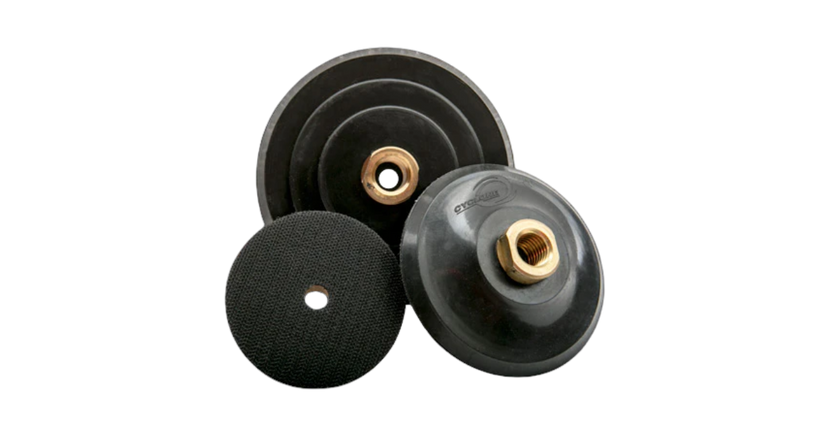
What Are Backer Pads? Understanding Their Core Function
Backer pads are circular mounting attachments used with polishers and grinders to support polishing pads, sanding discs, and abrasive tools during fabrication.
Most backer pads use:
-
hook-and-loop attachment systems
-
standard 5/8-11 threading
-
rubber, foam, or rigid composite backing materials
Their primary job is to create stable contact between the power tool and the abrasive surface.
Without a proper backer pad, polishing pads cannot maintain balanced contact against the stone surface. That lack of support affects both finish quality and polishing efficiency.
A backer pad helps:
-
Keep polishing pads centered during rotation
-
Stabilize the polishing surface at high RPMs
-
Distribute pressure more evenly
-
Reduce unnecessary vibration during polishing
The type of backer pad used changes how aggressively or smoothly the polishing pad interacts with the stone.
That becomes important when moving between flat polishing, curved edge work, sink cutouts, detailed profiles, and finish polishing stages.
Different fabrication tasks require different levels of flexibility and control.
Types of Backer Pads Used in Stone Fabrication
A. Flexible Backer Pads for Contours and Curved Stone Work
Flexible backer pads are designed to conform to curved or uneven surfaces while maintaining polishing pad contact.
They are commonly used when polishing:
-
sink cutouts
-
rounded corners
-
curved edges
-
decorative stone profiles
Unlike rigid pads, flexible designs allow the polishing surface to follow contours without gouging or creating uneven transitions.
The Alpha Flexible Backer Pads available through TSC are designed specifically for contour polishing and detailed fabrication work.
Their flexible construction helps operators maintain better surface contact on curved applications where rigid pads would struggle to conform evenly.
Why it matters:
Flexible polishing support helps reduce:
-
uneven gloss transitions
-
edge burn marks
-
pressure concentration on curves
That creates a smoother polishing progression between grit stages.
B. Rigid Backer Pads for Flat and Straight Polishing
Not every fabrication task benefits from flexibility.
Flat surfaces and straight countertop edges require controlled pressure and stable geometry during polishing.
Rigid backer pads are designed to maintain a flatter polishing plane with minimal flex during operation.
That stability becomes important when polishing:
-
straight countertop edges
-
stair treads
-
flat stone surfaces
-
vertical edge sections
The Alpha Rigid Backer Pads available from TSC are built for applications where maintaining flat edge geometry matters more than contour flexibility.
Rigid pads help prevent:
-
edge roll-over
waviness
-
inconsistent bevels
-
uneven edge shaping
This creates cleaner edge lines and more predictable polishing results.
When fabricators need consistent edge geometry across multiple slabs, rigid support helps maintain repeatability throughout the polishing process.
C. Foam and Specialty Backer Pads
Some polishing stages require additional cushioning and vibration control rather than aggressive material removal.
Foam-style backer pads help absorb vibration while improving operator control during finish polishing applications.
The Sandit® Foam Hook & Loop Backer Head offered by TSC is designed to provide controlled cushioning and smoother polishing transitions.
Its foam-backed construction helps:
-
reduce vibration transfer
-
improve polishing control
-
minimize swirl marks during finishing
These types of pads are often used during:
-
lighter polishing stages
-
finish refinement
-
final gloss development
More controlled contact pressure helps polishing pads move smoothly across the stone surface without digging aggressively into the material.
That becomes especially important during high-visibility finishing work.
When Backer Pads Are Used in the Fabrication Workflow
1. Wet Polishing Sequences
Backer pads are heavily used throughout wet polishing sequences.
As operators move through grit progression, the backer pad helps maintain:
-
even surface contact
-
smoother pad tracking
-
balanced polishing pressure
Without proper support, polishing pads can skip unevenly across the surface, creating inconsistent finishes.
Flexible and semi-rigid backer pads are commonly used during these polishing stages because they help adapt to slight surface variations while maintaining stable polishing control.
2. Edge Polishing
Stone edges require controlled polishing pressure.
Too much flex can over-round an edge. Too little control can create flat spots or uneven bevel transitions.
Rigid backer pads help maintain cleaner edge geometry during:
-
straight edge polishing
-
bevel refinement
-
edge cleanup work
That stability reduces the amount of corrective polishing needed later in the workflow.
3. Inside Curves and Sink Cutouts
Inside radii and curved sink openings create a different challenge.
Rigid polishing surfaces struggle to maintain even contact in tight contours. Flexible backer pads help polishing pads conform more naturally to curved surfaces.
This improves:
-
grit transition consistency
-
contour smoothness
-
polishing control inside curved sections
Detailed fabrication work depends heavily on proper pad flexibility.
Why Backer Pads Are Essential for Quality and Efficiency
A. Consistent Finish Quality
Backer pads directly influence finish consistency.
Proper pressure distribution helps operators achieve:
-
more uniform gloss levels
-
smoother polishing transitions
-
cleaner edge refinement
Uneven support usually creates visible inconsistencies during final inspection.
B. Extended Polishing Pad Life
Diamond polishing pads are expensive consumables.
Improper support causes pads to:
-
wear unevenly
-
tear prematurely
-
delaminate faster under stress
A properly matched backer pad helps distribute pressure more evenly across the polishing surface, extending consumable life and reducing replacement frequency.
C. Reduced Labor and Rework
The right backer pad improves workflow efficiency by reducing:
-
corrective polishing passes
-
inconsistent finish problems
-
unnecessary polishing time
That creates faster polishing cycles with more predictable results across multiple fabrication jobs.
Product Examples Available on TaitSales
Tait Sales offers multiple backer pad options designed for different fabrication applications.
Flexible Backer Pads
Alpha Flexible Backer Pads are designed for curved edges, sink cutouts, and contour polishing. Their flexible construction helps polishing pads maintain contact on rounded surfaces and inside corners without gouging the stone.
They feature hook-and-loop backing, fit most polishers with 5/8”-11 threads, and are available in 2”, 3”, 4”, and 5” sizes.
Shop Now: Alpha Flexible Backer Pads for contour and curved-edge polishing.

Rigid Backer Pads
Alpha Rigid Backer Pads are built for straight edges and flat polishing applications. Their rigid design helps reduce wavy finishes and keeps pressure even across the surface.
They work well for countertop edges, staircases, and flat stone polishing where consistent edge geometry matters.
Shop Now: Alpha Rigid Backer Pads for straight-edge and flat-surface polishing.
Foam & Specialty Backer Pads
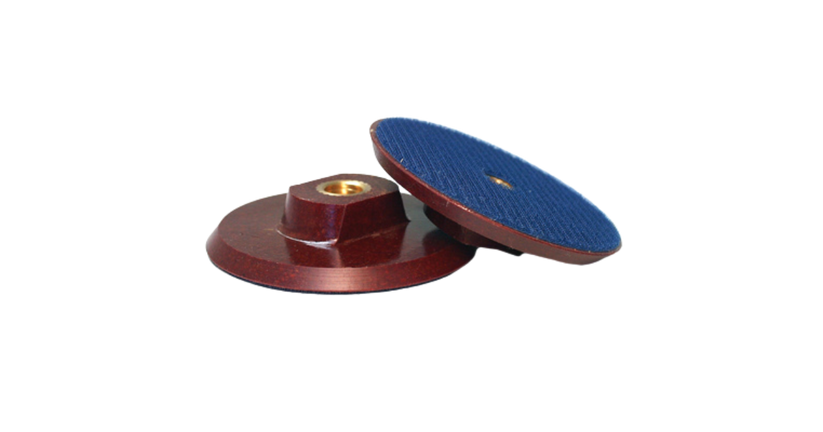
The SANDIT Foam Backer Head is designed for smoother, vibration-controlled polishing. Its foam construction helps reduce chatter and improve operator control during finish polishing.
The wedge-shaped design works with 5” Velcro polishing pads and supports high-RPM operation.
Shop Now: SANDIT Foam Backer Head for finish polishing and vibration reduction.

Maintenance and Best Practices
Backer pads perform best when inspected and maintained regularly.
Best practices include:
-
checking hook-and-loop surfaces for wear
-
replacing pads that lose stiffness or balance
-
matching backer pad diameter to polishing pad size
-
storing pads flat to prevent warping
Worn or damaged backer pads reduce polishing accuracy and increase unnecessary vibration during operation.
Routine inspection helps maintain finish quality and prolong polishing pad life.
Conclusion: Small Tool, Major Impact
Backer pads may seem like minor accessories, but they play a major role in professional stone fabrication.
They influence:
-
polishing consistency
-
surface control
-
pad stability
-
finish quality
-
consumable life
The right backer pad helps fabricators reduce rework, improve polishing efficiency, and achieve more predictable finishing results across granite, quartz, marble, and porcelain applications.
Choosing the correct combination of flexibility, rigidity, and support matters throughout every stage of polishing.
Explore professional-grade Backer Pads at Tait Sales & Consulting LLC to support your stone fabrication and finishing workflow.
FAQ's
Flexible backer pads sort of follow curved surfaces and small contours, so they conform while you work. Rigid backer pads keep a flatter polishing geometry, which is useful for straight edges and flat faces, even if they feel less forgiving.
Yes, but not usually in a “one size fits all” way. Many fabrication workflows perform better when different backer pad types are used for specific polishing stages and surface shapes.
Replacement depends on usage, applied pressure, heat exposure, and the condition of the hook-and-loop surface. Generally, backer pads should be replaced when support, balance, or polishing performance begins to decline.
Yes. Proper backer pad support helps polishing pads wear more evenly and can reduce tearing or premature delamination, extending pad life.
Flexible backer pads are typically the better choice for curved edges, sink cutouts, and contour polishing. They conform more naturally to uneven surfaces, providing better contact and control.
Robert Tait
Robert Tait is a senior sales and operations leader with over 30 years of experience in manufacturing and distribution. Based in Overland Park, Kansas, he is the President of Tait Sales & Consulting LLC (TSC), a family-owned and operated venture he founded in 2019. TSC was founded to provide diamond tooling, material handling, and all related consumables to the natural stone industry. The industries have now expanded to include, construction, glass, tile, masonry, hardscape and concrete industries.